Confused About Your Next Fencing Project? - Quikfence

A few tips to prepare for your next rural fencing project
fencing project 2 640w

Fencing can be a time consuming, expensive and a lot of hard work. Options include the DYI model, or hire an experienced Fencing Contractor while you get on with what you normally do. 


An experienced Fencing Contractor will get the job done quicker, and likely produce a better fence than the average farmer. After all it’s what they do, and it’s a tough job. Recent weather events have created a shortage of available Contractors as they are run off their feet repairing and replacing flood damaged fences across the country. Ongoing wet weather has exacerbated this situation.


This is forcing is many farmers, and rural landowners down the DIY model to consider the best way to fence their property to protect their livestock, crops and homes. Depending on the size of your fencing project do you hire the equipment, which not always available, or do you buy. 


Working on the basis your fencing project is going to take weeks, and not days, plus you know you are going to be this again at some stage, perhaps investing in equipment does make sense.

Here’s a couple of key points to consider as you prepare

  • Size and length of rolls likely to be used? 
    Are you able to lift and move them around relatively easily, or is this going to be challenge?
  • How many people do I need to put the fence up?
    This is good time to consider if you don’t have fencing machinery and equipment, how many people will I need? Also, the time you will need to pay for these people, verses the cost of buying the machinery.
  • Time, how much have you got? 
    Consider whether you have plenty of time, or do you need to get this done before the next harvest, wet season, stop damage to crops and stock from feral pests, etc.
  • Over a three, five or ten year period are you likely to fence again?
    If the answer yes, the value of having your own equipment on hand when you need it usually greatly favours making a purchase. If not, consider the impact if you do not proceed with equipment purchase on the fencing project.


Ok, you’ve decided to purchase some fencing equipment, what to do next.


If it’s been awhile since the current fence was erected, consider has there been improvements on the available materials. Over recent years many manufactures have improved the longevity of there products, plus there are stronger and improved options are now available. Check around and ask leading suppliers what’s available.


Going to use fabricated (mesh wire) rolls
Fabricated or mesh rolls are ideal for exclusion fencing, external and internal fencing. Depending on the local feral pest situation, plus what you want to keep in, protect, will determine the height of the roll and whether you need an apron.


Best way to handle the fabricated rolls
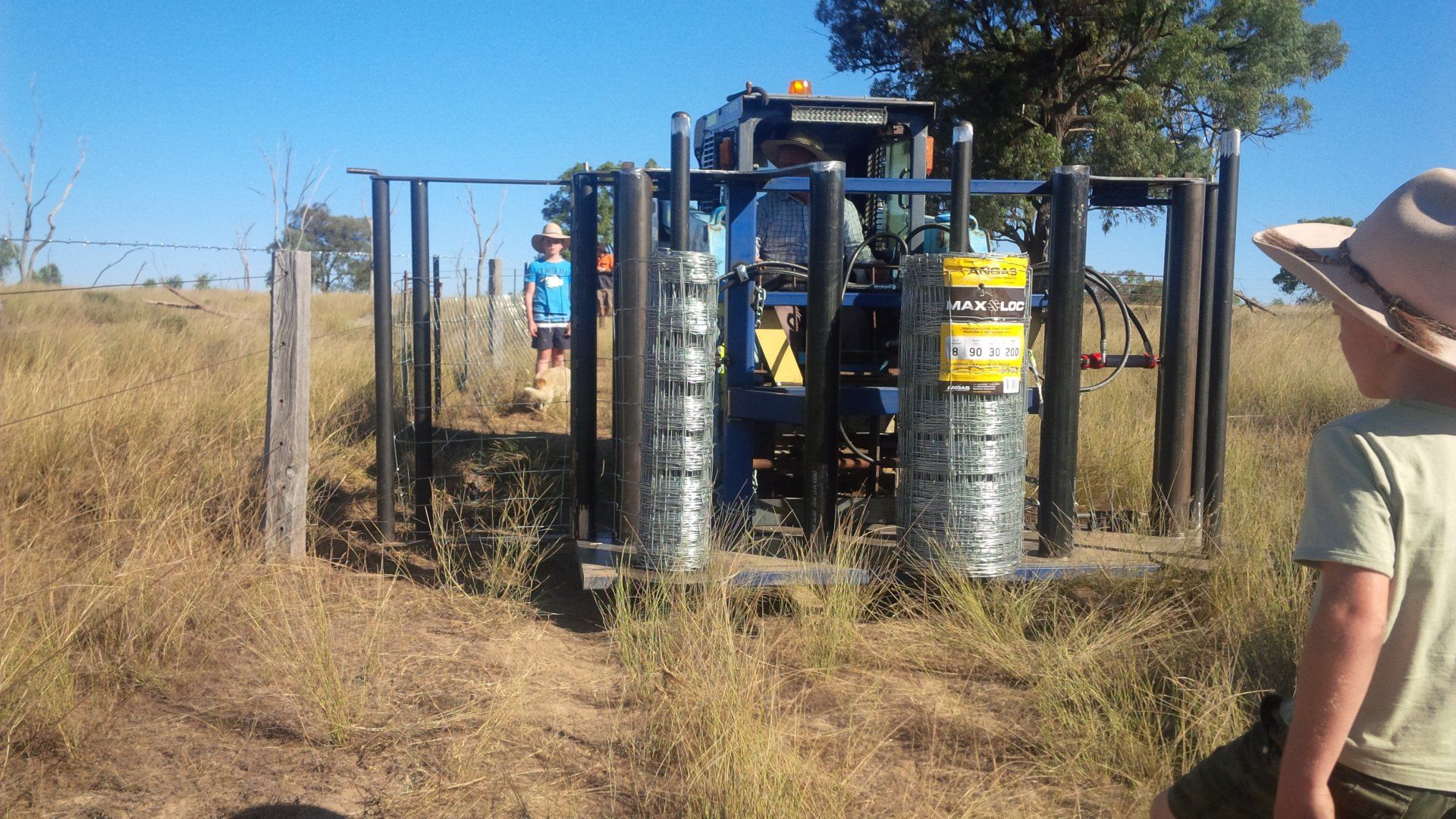
Rolls of wire can be difficult to handle, seem to get heavier by the end of the day and the longer the project takes. To reduce fatigue, plus lift and handle the rolls of mesh, fencing equipment is available and has been around long enough to know which machines to trust.


What to know when purchasing fencing machinery
To get the best value out of your purchase for fencing equipment, ideally jot down what type and size rolls you are going to be using. Allow for different heights, and lengths and prepare for the longest, biggest and heaviest. Then consider how many rolls can you fit in on the fencing machine to make the purchase worthwhile saving you time and mucking about on the job.


Key points to check when purchasing a fencing machine;

  • Check the machine has hydraulics that enable the equipment to lift the rolls.
    Or do you need to manually lift and load the rolls?
  • A clamping mechanism to help tension the wire while you tie it off.
  • Clamping mechanism on both sides of the machine so it doesn’t matter which way you run down the down line.
  • Make sure the machine looks sturdy and has some weight about it. After all, fencing rolls can be quite heavy so, you don’t want something light that will not stand the test of time.
  • Consider what parent machine the equipment is going on, and whether this will change down the track. Are there options for this from the fencing equipment supplier?
  • The size of the project, the terrain and likelihood of redoing it again at some point. 
    The optimum way to go is, purchase equipment that can handle the future fencing needs not just todays.
  • Second hand resell value if you decide to sell after the you’ve completed the project.
    The ability to sell the equipment at a good price after the project is completed is a good indicator of the value of the machinery.
  • The budget and available funds can determine which way you need to go.
  • Back up and support from an organisation that is focused and has a depth of fencing equipment experience and manufactures their machinery locally in Australia.

If you would like to know more or get help on your next fencing project, contact QuikFence.

☎️ 1800 062 723

📨 info@quikfence.com.au

🌐 quikfence.com.au


The Post by QuikFence

by Jon Earl 11 September 2026
Learn how to rebuild flood-damaged farm fencing safely, from assessing damage and salvaging materials to choosing the right equipment and rebuilding for future floods.
by Jon Earl 4 September 2026
Time lost on a fencing job rarely comes back. The season opens, the ground is workable, and there's a long run to get through before conditions change. Most people underestimate how much the choice of equipment shapes how that run actually goes. The gap between manual post driving and a post driver for a skid steer is bigger than most expect before they've experienced both side by side. The Reality of Manual Post Driving Manual post driving works. But working and working efficiently across a full day are two different things. Every post requires the operator to position equipment by hand, strike repeatedly, check alignment, correct if needed, and move on. On a short job with easy ground, that's manageable. Once the run stretches out, it becomes the thing that eats the day. Depth varies from post to post. Alignment drifts. The operator tires and small errors start creeping in before anyone notices. A job that looked achievable in the morning starts pushing into the next day. That's not a failure of effort. It's the natural limit of what manual methods can sustain across a serious fencing run. What Changes When a Skid Steer Gets Involved The operator stays in the cab throughout. The machine repositions between posts without anyone climbing off or dragging equipment into position by hand. The fence post driver handles the impact. The operator handles placement. That shift alone changes the pace of the whole job. The bigger change is consistency. Controlled hydraulic force delivers the same result post after post. Depth stays uniform. Alignment stays cleaner across the run. The small corrections that cost manual operators minutes at a time stop being a constant part of the day. ere the Time Actually Goes Faster driving is the obvious saving. A skid steer post driver gets through a post in a fraction of the time manual methods take. Across hundreds of posts, that adds up to hours, not minutes. Fewer corrections is the next one. Posts that go in consistently straight don't need adjusting. A fence line built with uniform depth and clean alignment doesn't need rework once the wire is up. Less fatigue is the saving that doesn't get counted but matters most. The physical load stays on the machine rather than the operator. The pace that starts the morning holds through the afternoon in a way that manual driving simply can't match once the day gets long. Hard Ground Is Where the Gap Really Opens Up On easy ground, manual post driving is slow. On hard ground it becomes genuinely difficult to sustain Compacted clay, rocky sections, ground baked dry across an Australian summer. These are the conditions where manual methods lose hours that don't come back. Progress slows, and the results get inconsistent just when the job needs them most. A post driver handles those changes without the operator having to compensate manually. The hydraulic system responds to resistance and the job keeps moving. In particularly tough or difficult to access sections, the PostPuncher can work on slopes, over ditches, and into spots where manual driving simply isn't a realistic option. Access Is Part of the Time Equation Too Manual driving means carrying or dragging equipment to each post location. A fence post driver on a skid steer moves with the machine. Tight corners, steep creek banks, narrow sections near yards and sheds. A skid steer gets into those spots without the setup that larger machinery requires. Less time getting to the post means more time actually driving it. What the Difference Looks Like Across a Season On a single job, the time saving is noticeable. Across a full season of fencing work, it becomes significant. Faster installation. Fewer corrections. Less fatigue dragging down the second half of the day. Better access across sections of the property that used to cause delays. All of it adds up across every run the season brings. For anyone still relying on manual methods for regular fencing work, the question isn't whether a skid steer post driver saves time. It's how much time has already been lost without one. QuikFence supplies a range of post drivers suited to skid steers and Australian conditions, including the PostPuncher, FencePro, and ThunderPro. Get in touch with our team to know which machine suits your work.
by Jon Earl 17 August 2026
Discover 7 signs it's time to upgrade your post driver, from slow jobs and operator fatigue to hard ground, safety concerns and costly downtime.
by Jon Earl 7 August 2026
Comparing the KingHitter and Bryce Suma post rammers? See how each hydraulic post driver performs so you can choose the right fit for your fencing needs.
Steer Post Driver
by Jon Earl 31 July 2026
Learn how a skid steer post driver reduces operator fatigue, improves fence quality, and speeds up post installation across Australian farms.
 Skid Steer Post Driver
by Jon Earl 24 July 2026
Choosing a skid steer post driver? Compare hydraulic, percussion & front-mounted options from QuikFence to match your ground, machine & posts.
Post drivers for sale
by Jon Earl 16 July 2026
Keep your post driver in top condition with practical maintenance tips to extend equipment life, improve performance and reduce downtime.
by Jon Earl 6 July 2026
Learn how the KingHitter post driver outperforms traditional post rammers with improved safety, consistent performance, and greater efficiency.
by Jon Earl 30 June 2026
Discover why more Australian farmers are investing in post-driving equipment to improve fencing efficiency, reduce labour, and boost productivity.
by Jon Earl 19 June 2026
Discover why contractors choose tractor mounted post drivers over standalone models for faster fencing, greater precision, less labour and consistent results.
More posts