How to Choose the Right FastFencer for Your Farm?
This is a subtitle for your new post
The body content of your post goes here. To edit this text, click on it and delete this default text and start typing your own or paste your own from a different source.
Looking after livestock becomes tens times easier with a properly fenced perimeter. Since the earliest times, fencing has taken many forms and has seen many uses in residential properties and farms.
Having the right fencing solution on your farm keeps you prepared to protect your livestock and crops, secure your property, and ensure smooth farm operations. With so many options available, choosing the right quick-release bracket can seem overwhelming. However, having knowledge about the peculiar requirements of your farm and the features of various fencing speeds, you can determine choices that will favour your farm for several years to come.
Understanding the Importance of a FastFencer
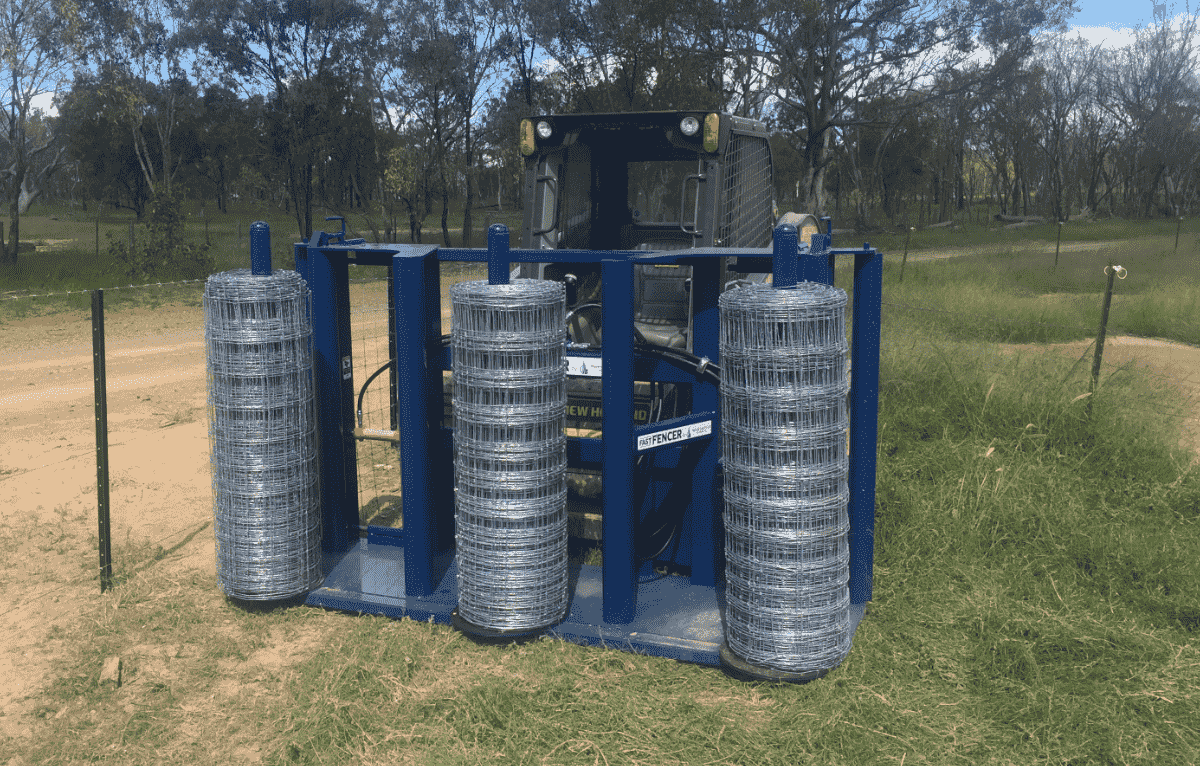
A FastFencer is a wire spinner designed for quick and efficient installation, making it ideal for farmers who need to establish boundaries or enclosures without delay. Unlike traditional fencing methods, which can be time-consuming and labour-intensive, FastFencer offers a streamlined approach, saving time, labour, and money. They are therefore especially useful in situations requiring temporary fencing or on large properties.
Exploring FastFencer Options
Let’s explore the different FastFencer options available. Here are some popular choices:
FastFencer 1300 Series
FFD1300/2400
The FFD1300/2400 is perfect for those with skid steers and smaller tractors. It’s compact and lighter, making it ideal for hilly terrains and smaller machines.
- Capacity: Holds 3 rolls up to 250 meters each
- Dimensions: 1300mm high x 2400mm wide x 850mm deep
- Weight: 540kg
- Ideal For: Running out standard hinge joint, fabricated netting, and Wallaby netting
- Best Uses: Sheep, goats, other livestock, tree protection, and internal/external fencing
This model is all about stability and ease of use on smaller machines. If you're dealing with challenging terrains and need a reliable, lightweight option, the FFD1300/2400 is a solid choice.
FFD1300/3000
Next, we have the FFD1300/3000, a wider variant that’s ideal for larger tractors, backhoes, loaders, and telehandlers. The extra width helps prevent the fence netting from snagging on wheels.
- Capacity: Holds 3 rolls up to 250 meters each, with an option for 500 meters
- Dimensions: 2100mm high x 3000mm wide x 850mm deep
- Weight: 780kg (800kg for the 500-meter roll model)
- Ideal For: Standard hinge joint, fabricated netting, Kangaroo proof fence, exclusion netting, and feral netting
This model is particularly useful for larger exclusion fencing projects, offering the flexibility and capacity needed for extensive fencing work.
FFD1300/2400/Side Shift
For added versatility, consider the FFD1300/2400/Side Shift. This model allows the entire fencing machine to move 300mm to the left or right, similar to forklift forks.
- Capacity: Holds 3 rolls up to 250 meters each, with a 500-meter option available
- Dimensions: 1300mm high x 2400mm wide x 850mm deep
- Weight: 580kg (heavier base for 500-meter option)
This side shift feature is a game-changer, enabling you to extend the reach of your FastFencer without moving the parent machine. It’s perfect for both hilly and open country, and the compact width ensures it can be transported easily without being classified as a wide load.
FastFencer 2100 Series
FFD2100/2400
Moving on to the FFD2100 series, the FFD2100/2400 is designed for telehandlers, small tractors, loaders, and backhoes. It’s built robustly to handle larger rolls.
- Capacity: Holds 3 rolls up to 250 meters each, with a 500-meter option
- Dimensions: 2100mm high x 2400mm wide x 850mm deep
- Weight: 710kg (740kg for the 500-meter roll model)
- Ideal For: Major vermin fence projects, standard hinge joints, fabricated netting, and more
If you're tackling significant fencing projects, this model’s heavier base and reinforced structure make it a reliable choice.
FFD2100/3000
The FFD2100/3000 is a wider option in the 2100 series, perfect for larger tractors and machines, ensuring the fence netting doesn’t get caught on the wheels.
- Capacity: Holds 3 rolls up to 250 meters each, with a 500-meter option
- Dimensions: 2100mm high x 3000mm wide x 850mm deep
- Weight: 780kg (800kg for the 500-meter roll model)
- Ideal For: Standard hinge joint, fabricated netting, exclusion netting, and more
This model is particularly well-suited for exclusion fencing projects, thanks to its capacity and robust build.
FFD2100/2400/Side Shift
Lastly, the FFD2100/2400/Side Shift variant offers the same side-shifting capability as its 1300 counterpart, providing an extended reach without moving the parent machine.
- Capacity: Holds 3 rolls up to 250 meters each, with a 500-meter option
- Dimensions: 2100mm high x 2400mm wide x 850mm deep
- Weight: 830kg (850kg for the 500-meter roll model)
This model combines capacity, versatility, and ease of transport, making it ideal for both challenging terrains and open fields.
FastFencer Jr.
The FastFencer Jr. is designed for people who want the option of carrying one or two fence rolls at once. It is smaller and lighter than a regular wire spinner and suits a parent machine that is 100HP or less.
FastFencer Jr machine options
- One roll machine to carry 250m rolls
- Two roll machines to carry 250m rolls
- 1300mm high machines, ideal for regular fence projects
- 2100mm high machines, suit exclusion fencing projects
FastFencer Jr. fits the gap that hasn’t been accessible with heavy-duty fencing machinery. It is ideal to be attached to small parent machines. Because of its lightweight, it is ideal for excavators, skid steers, small tractors only and mini diggers.
Key Features to Look for in a FastFencer & Fencing
When choosing a FastFencer, there are several key features to consider:
- Ease of Installation: The main advantage of a FastFencer is its quick installation. Look for fencing options that require minimal tools and can be installed by a small team or even one person.
- Durability: Regardless of whether a momentary or enduring remedy is required, strength is all the time of utmost importance. The fence should continue standing during the stormy season, animal pressure as well as other external conditions.
- Adaptability: A good FastFencer should be adaptable to different terrains and purposes. Consider options that allow for easy adjustments or extensions.
- Visibility: For fences used with animals like horses or deer, visibility is especially crucial because these animals are prone to mishaps if they can't see the barrier. Reflective markers or tapes in vibrant colours can increase safety.
- Maintenance Requirements: Consider the long-term maintenance needs of the fence. Some materials require regular upkeep, while others are more low-maintenance. Choose a fence that aligns with your capacity to maintain it.
Keep Fence and Fencing Machines Always In-Check
Choosing the right FastFencer for your farm is an important decision that will affect the safety and efficiency of your operations. By considering the unique needs of your farm and considering the different options available, you can choose a FastFencer that provides the right balance of durability, ease of driving fence wire and efficiency.
For more information on FastFencer options and expert advice on installation, contact
QuikFence
today. Our team is ready to help you find the perfect fencing solution tailored to your farm's needs.
The Post by QuikFence